Camouflage record
Leibermuster
The Leibermuster Camo was developed by Germany in 1945 during the final stages of World War II. It features irregular shapes in dark green, brown, black, and pale green, designed to provide concealment in both woodland and urban environments. Notably, it was one of the first camouflage patterns to incorporate infrared reflectance, marking an early attempt at countering infrared detection technology. Although never widely fielded, its technical innovation influenced future developments in military camouflage.
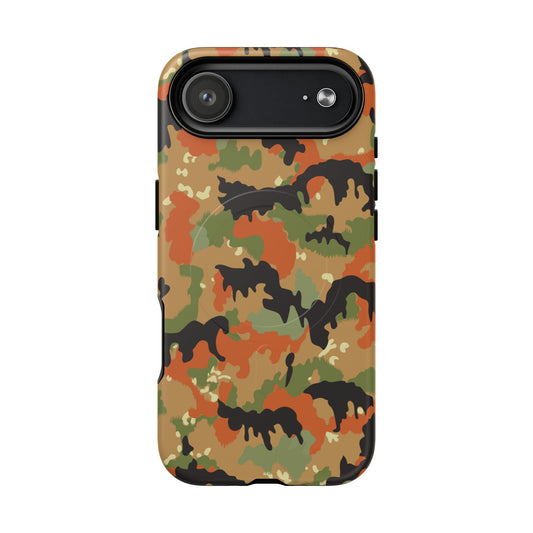
Leibermuster Camo MagSafe iPhone 17 Field Case
Couldn't load pickup availability
Leibermuster camo MagSafe iPhone 17 field case in dual-layer polycarbonate and black TPU. The case uses a full-wrap Leibermuster camouflage print with a rigid outer shell, shock-absorbing inner liner, and magnetic module for MagSafe-compatible chargers, wallets, and mounts.
The full-wrap camouflage repeat is scaled for the iPhone 17 case body, keeping the pattern legible across the back surface and wrapped edges. The compact case format puts the camouflage repeat across the back and sides of the device, turning the iPhone 17 into a small equipment surface rather than a plain accessory.
Matte finish. MagSafe compatible. Dual-layer construction with impact-resistant polycarbonate exterior and flexible TPU lining. Raised bezel helps protect the screen and camera edges during daily carry.
Specs
- Camouflage: Leibermuster
- Format: iPhone 17
- Materials: polycarbonate outer shell, black TPU inner lining
- Matte protective finish
- Full-wrap print on exterior surfaces
- Raised bezel at screen and camera edges
- MagSafe® compatible
- Impact resistant
Care instructions
- Clean the case with soft, damp cotton or microfiber cloth. Avoid using chemicals.
Shipping & returns
Free US shipping on orders over $95. Shipping calculated at checkout. 30-day returns, with free return shipping in the US and Canada.
Camouflage record
Leibermuster
The Leibermuster Camo was developed by Germany in 1945 during the final stages of World War II. It features irregular shapes in dark green, brown, black, and pale green, designed to provide concealment in both woodland and urban environments. Notably, it was one of the first camouflage patterns to incorporate infrared reflectance, marking an early attempt at countering infrared detection technology. Although never widely fielded, its technical innovation influenced future developments in military camouflage.