Camouflage record
Mitchell
During WWII, the Marine Corps officially experimented with the M-42 Frog Skin battledress camouflage, while other U.S. troops, especially airborne pathfinders in Normandy, used hand-painted splotches, stripes, and foliage for camouflage. After the war, the US Military sought to develop a broader camouflage pattern. Between 1948 and 1953, field tests led to a trial in Panama of eight designs. Two complementary patterns emerged as effective: the green-hued Wine Leaf for spring and summer, and the brown Mitchell pattern for fall and winter, named after artist and former Marine Meldon Mitchell. This combination was implemented in the two-sided Pattern-53, with Mitchell becoming synonymous with both sides.
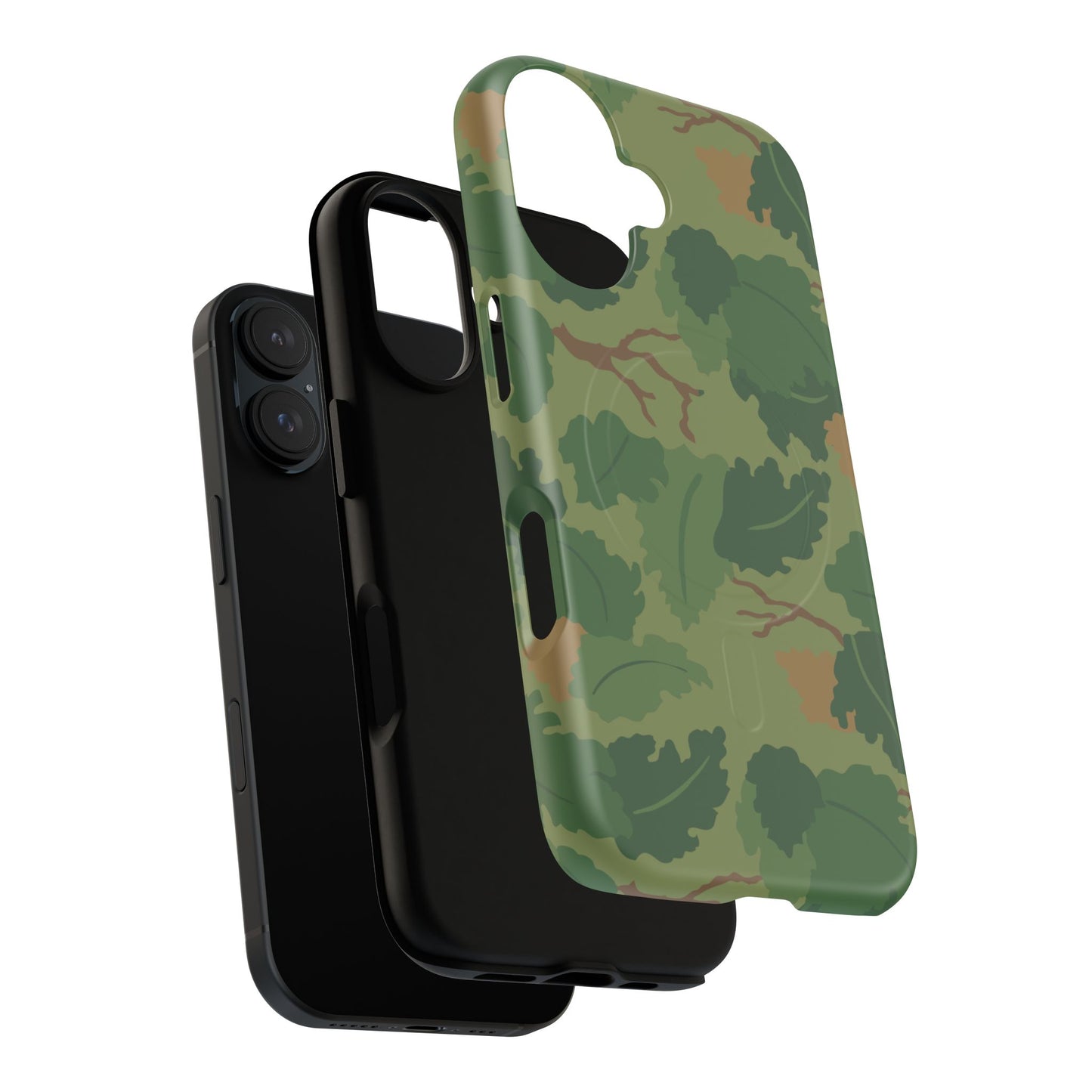
Mitchell Camo MagSafe iPhone 16 Field Case
Shipping calculated at checkout
Couldn't load pickup availability
Mitchell Camo MagSafe iPhone 16 field case in dual-layer polycarbonate and black TPU. The case uses a full-wrap Mitchell Camo print with a rigid outer shell, shock-absorbing inner liner, and magnetic module for MagSafe-compatible chargers, wallets, and mounts.
The repeat is scaled for the iPhone 16 case body, carrying the camouflage across the back panel, wrapped edges, and camera-side geometry without losing the pattern field. The format turns the phone into a compact equipment surface while keeping the artwork specific to the iPhone 16 silhouette.
Specs
- Camouflage: Mitchell
- Format: iPhone 16
- Materials: polycarbonate shell, black TPU lining
- Dual-layer construction, impact resistant
- Raised bezel around screen and camera
- Matte finish
- Full-wrap print
- MagSafe compatible
Care instructions
- Clean the case with soft, damp cotton or microfiber cloth. Avoid using chemicals.
Shipping & returns
Free US shipping on orders over $95. Shipping calculated at checkout. 30-day returns, with free return shipping in the US and Canada.
Camouflage record
Mitchell
During WWII, the Marine Corps officially experimented with the M-42 Frog Skin battledress camouflage, while other U.S. troops, especially airborne pathfinders in Normandy, used hand-painted splotches, stripes, and foliage for camouflage. After the war, the US Military sought to develop a broader camouflage pattern. Between 1948 and 1953, field tests led to a trial in Panama of eight designs. Two complementary patterns emerged as effective: the green-hued Wine Leaf for spring and summer, and the brown Mitchell pattern for fall and winter, named after artist and former Marine Meldon Mitchell. This combination was implemented in the two-sided Pattern-53, with Mitchell becoming synonymous with both sides.