Camouflage record
Portuguese Lizard
The Portuguese Lizard Camouflage (M1964 or m64) was developed in the 1960s for Portugal’s decolonization wars, particularly in Angola, Mozambique, and Guinea-Bissau. Designed for superior concealment in dense jungle and savanna environments, it features vertical dark green and brown stripes on a light green background, optimizing its effectiveness in wooded and tropical terrains. Inspired by the French TAP47 and TAP56 Lizard camouflages, the Portuguese variant was adapted to suit the combat needs of elite units such as paratroopers, commandos, and special forces.
Unlike its French predecessor, which had a more horizontal orientation, the vertical alignment of the Portuguese Lizard pattern was intended to reduce visibility when soldiers were moving upright through jungle foliage. The pattern continues to be used today by the Portuguese Marines (Fuzileiros) and remains one of the longest-serving camouflage designs in military history.
Portuguese Lizard · Women's Swimwear
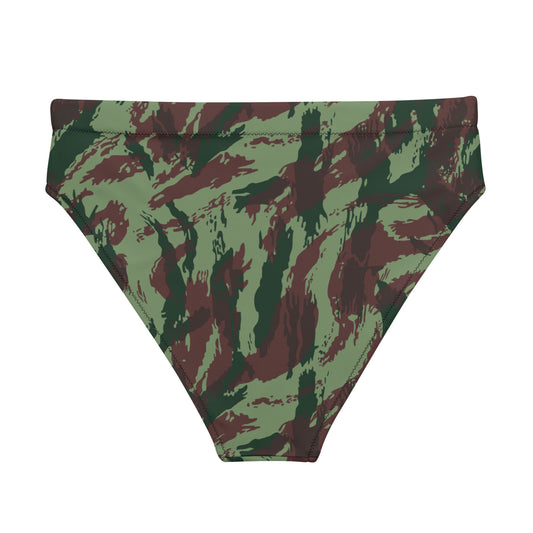
Portuguese Lizard Camo High-Waisted Bikini Bottom
Shipping calculated at checkout
Couldn't load pickup availability
Portuguese Lizard Camo high-waisted bikini bottom in polyester-elastane swim fabric, cut with a high-rise waist and double-layered, non-reversible construction. Olive and brown brushstroke bands with dark interruptions run across the front and back, giving the wider waist panel a defined directional print. The rise covers more of the midsection than a string bikini bottom, while zigzag stitching lets the edges stretch with the fabric.
US production uses 78% polyester and 22% elastane; EU production uses 88% recycled polyester and 12% elastane. A tear-away care label reduces bulk inside the brief. Sizes run XS–3XL, with the matching padded top sold separately.
Size guide
| WAIST (inches) | HIPS (inches) | |
| XS | 25 ¼ | 35 ⅜ |
| S | 26 ¾ | 37 |
| M | 28 ⅜ | 38 ⅝ |
| L | 31 ½ | 41 ¾ |
| XL | 34 ⅝ | 44 ⅞ |
| 2XL | 37 ¾ | 48 |
| 3XL | 41 | 51 ⅛ |
Specs
- Double-layered and non-reversible
- Tear-away care label
- Zig-zag stitching
Traceability & materials
- 78% polyester, 22% elastane for production in the US/Mexico
- 88% recycled polyester, 12% elastane for production in Latvia
- Fabric weight: 8.56 oz./yd.² (290 g/m²) in the US/Mexico
- Fabric weight: 6.78 oz./yd.² (230 g/m²) in Latvia
- Blank product components sourced from Mexico and Spain
Shipping & returns
Free US shipping on orders over $95. Shipping calculated at checkout. 30-day returns, with free return shipping in the US and Canada.
Camouflage record
Portuguese Lizard
The Portuguese Lizard Camouflage (M1964 or m64) was developed in the 1960s for Portugal’s decolonization wars, particularly in Angola, Mozambique, and Guinea-Bissau. Designed for superior concealment in dense jungle and savanna environments, it features vertical dark green and brown stripes on a light green background, optimizing its effectiveness in wooded and tropical terrains. Inspired by the French TAP47 and TAP56 Lizard camouflages, the Portuguese variant was adapted to suit the combat needs of elite units such as paratroopers, commandos, and special forces.
Unlike its French predecessor, which had a more horizontal orientation, the vertical alignment of the Portuguese Lizard pattern was intended to reduce visibility when soldiers were moving upright through jungle foliage. The pattern continues to be used today by the Portuguese Marines (Fuzileiros) and remains one of the longest-serving camouflage designs in military history.